
A Bone to Pick
How I became a biblical literalist

There is something fishy about the biblical “rib”.
You know, the one God took from Adam, to make Eve?
I realized that something did not add up when I was about ten years old. Went to the museum during day-camp one summer. Saw a real human skeleton for the first time—a pair, actually. One male and one female.
“What differences do we notice between the two?” the counselor asked.
I made a quick count. My hand shot up, then I spoke without waiting to be called on. I was that kind of kid.
“The female’s has one more set of ribs” I said.
She frowned. looked over at the skeletons.
“No-o-o,” she said, “but great bible knowledge!”
Mortifying! I had miscounted—missed a floating rib on the male or something—and there’s nothing worse to a know-it-all kid than being so publicly, obviously wrong.
But looking back, I’m proud of young Stephen for making that assumption. in first grade, our teacher had read us a folk tale about why Anansi the spider has long legs, and even at that young age I understood: these stories are for explaining the world.
Anthropologists call them Just-So stories: Hephaestus thunders away in his forge, hard at work on Zeus’s next lightning bolt. Pyramus and Thisbe bleed out under a mulberry tree, and the gods of Babylon enchant the tree such that its fruits—which sprout milky white from the branch—ripen to a bloody red-black forevermore.
Genesis
So in what WEAK-ASS cosmology does your supreme deity take a bone from the prototype of your species, and then the next generation it just...what, grows back? Imagine someone tried to tell you about the time God took the stripe from the skunk! Such a story could only be entertained in anticipation of the next installment, “How Skunk Got Her Stripe Back”, right?
So why, in the first chapter of the first book of the foundational text of the most popular religions on Earth, is there a Just-So story about “why man is missing a rib”?
I suppose if you earnestly believe “Oh all those other stories that follow the same form, THOSE are myths, but this is a true, literal account of how God created women”, then it doesn't have to make sense through an anthropologist’s lens. But if you see the Abrahamic creation myth as being fundamentally no different from the Babylonians’, or the Hopi’s, it is so obviously a just-so story about “why man is missing a rib” that my ten-year-old self felt comfortable making assumptions about human anatomy based on it.
What gives?
Well, a few years ago I got curious: does the original text really specify a “rib”, like from the ribcage? After all, YHWH did not hand the Commandments down to Moses on stone tablets written in the King’s English; the version of the bible that most of us are familiar with is the product of a millennia-long game of Telephone. Theologians have been grappling with the implications of this since the Coptic Bibles were written, because if you want to seriously claim that your text is the Sacred and Incorruptible Word of God, you find yourself asserting that God spent a lot of the fourth century peering over the shoulders of scribe monks as they hand-copied manuscripts going “sorry, that’s an i, not a j”.
No trouble for the omnipresent Almighty, to be sure, but very out of character after the whole Tower of Babel thing.
Fortunately, we still have the Hebrew—the closest we’re ever gonna get to the original text as-written—and Strong’s Concordance, an exhaustive scholarly effort which indexes each time a word is used in the book, so you can compare and use context clues to deduce what the ancients might have meant.
And if you check Strong’s…
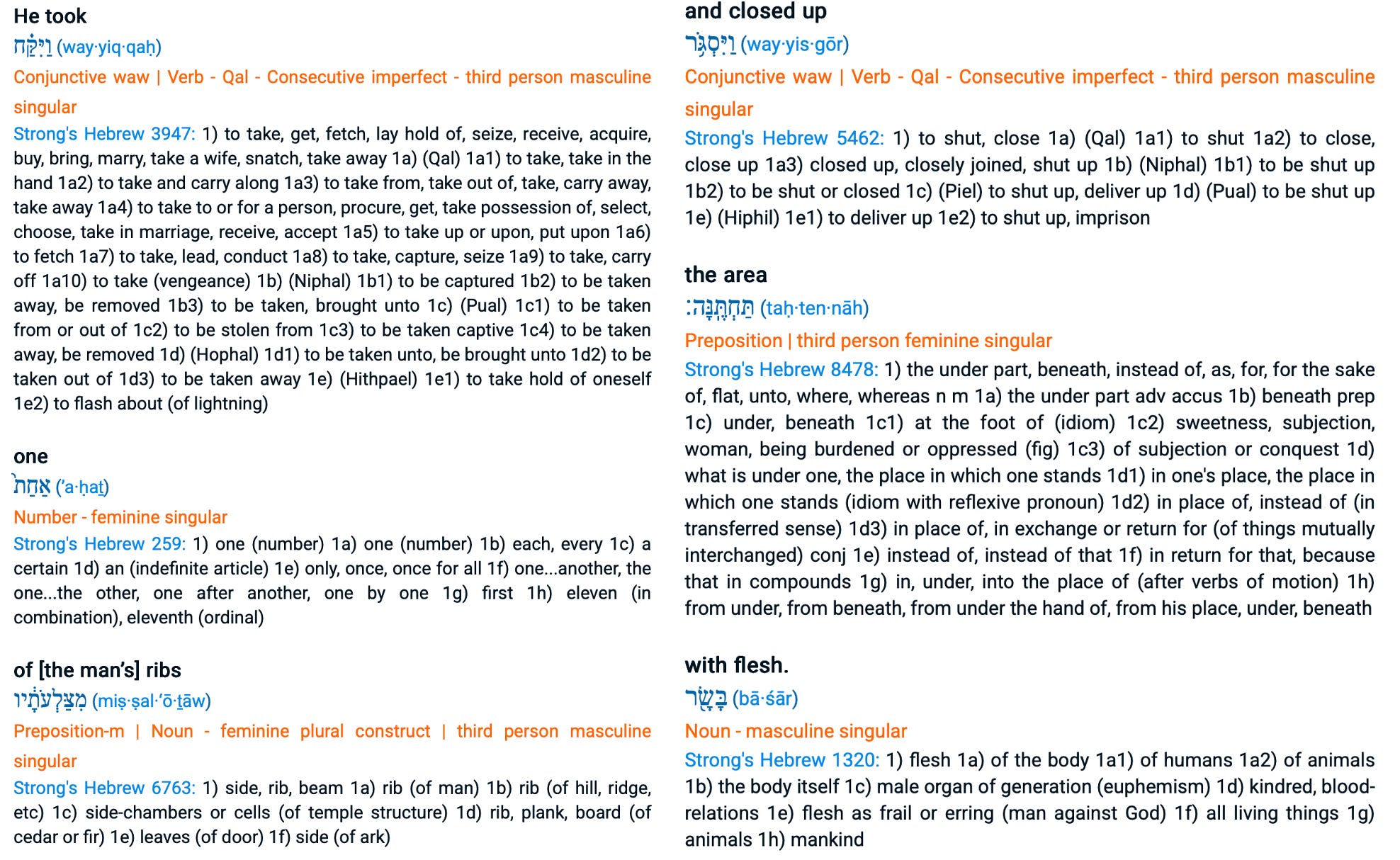
Aha! There’s apparently some flex in the translation of the word commonly taken to mean “rib”. It can refer to a wooden plank—any kind of structural beam, really. Also worth noting: it’s very clearly not a set of ribs, or a pair; it’s one bone. If it came from the ribcage, this would seem to be a just-so story about why humans have a slight asymmetry. But the thing that really caught my attention were the final two words of the sentence. תַּתַּחְתֶּֽנָּה׃ (taḥ·ten·nāh) comes from תַּחַת, tachath, which means “below” or “under” in practically every context where it’s used. And the final word, בָּשָׂ֖ר (bā·śār)…
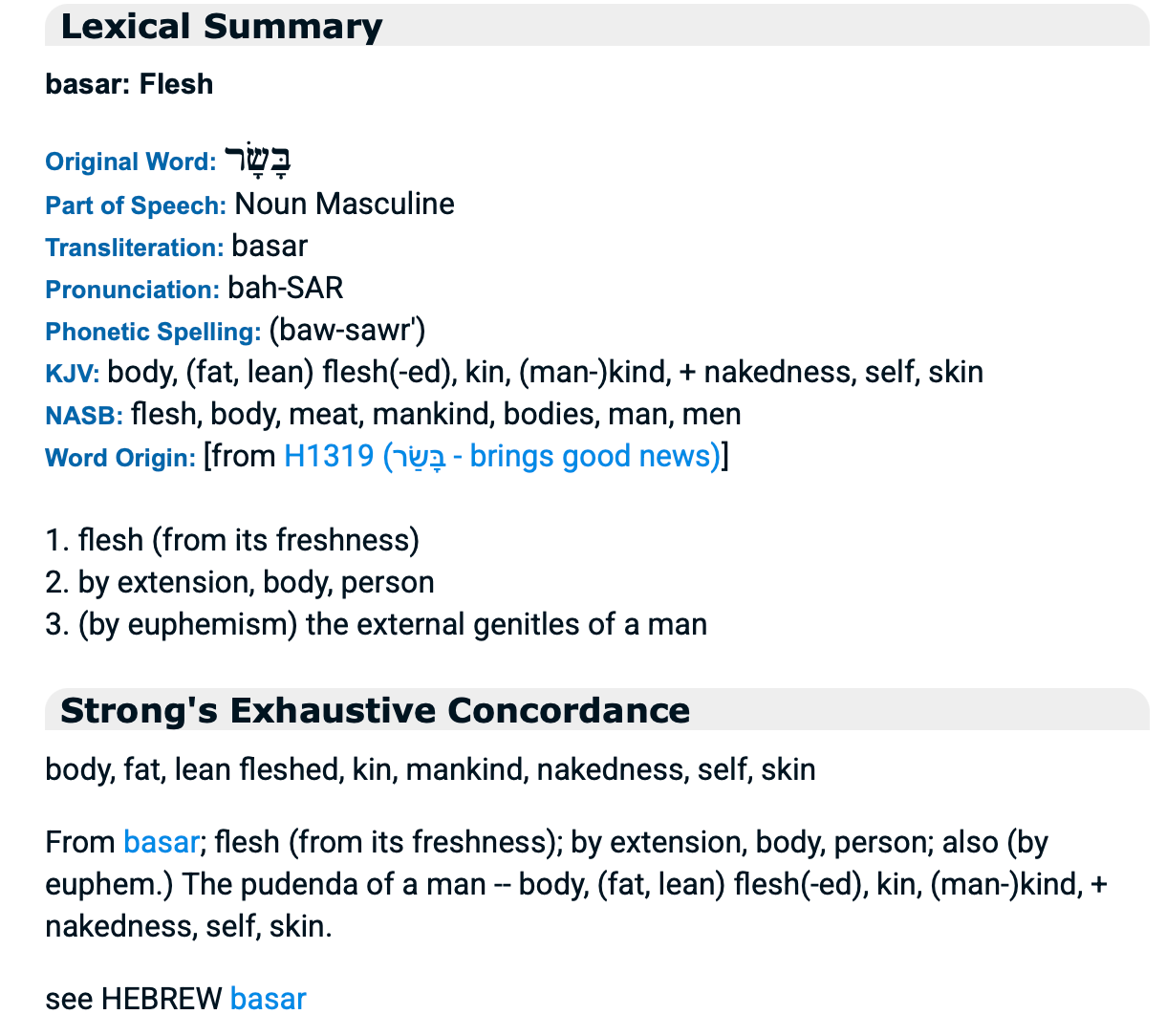
There’s a reading of Genesis 2:21 that goes: “…and sealed him up underneath the dick.”
And the moment I saw those words, three memories collided in my mind.
The first was of my embarrassment at summer camp all those years ago; my confusion.
The second, a memory of being a very young boy, of examining my own body and really noticing this suture-like seam between my legs for the first time. Bending over and looking in the bathroom mirror at it, wondering. Imagining for a minute that maybe I was born a hermaphrodite and they had sewn me up.
The third memory was of a bit of anatomical trivia.
See, the human male is missing a bone—not compared to the female of his species, but relative to the males of most other species of animal.
We alone among our closest cousins, the great apes, are the only ones without a baculum.
A penis bone.
Boneless Tenders
And as these recollections flashed before my eyes, I was struck with an almost religious certainty. I could see the ancestors, butchering a bird or a bear, going “huh, these guys have one too.” Looking down, wondering what makes us different, speculating.
I went “has anyone else thought of this?” and of course, there’s nothing new under the sun; I found an article from the American Journal of Medical Genetics, Gilbert & Zevit (2001)—postulating this very same thing, on basically the same line of evidence.
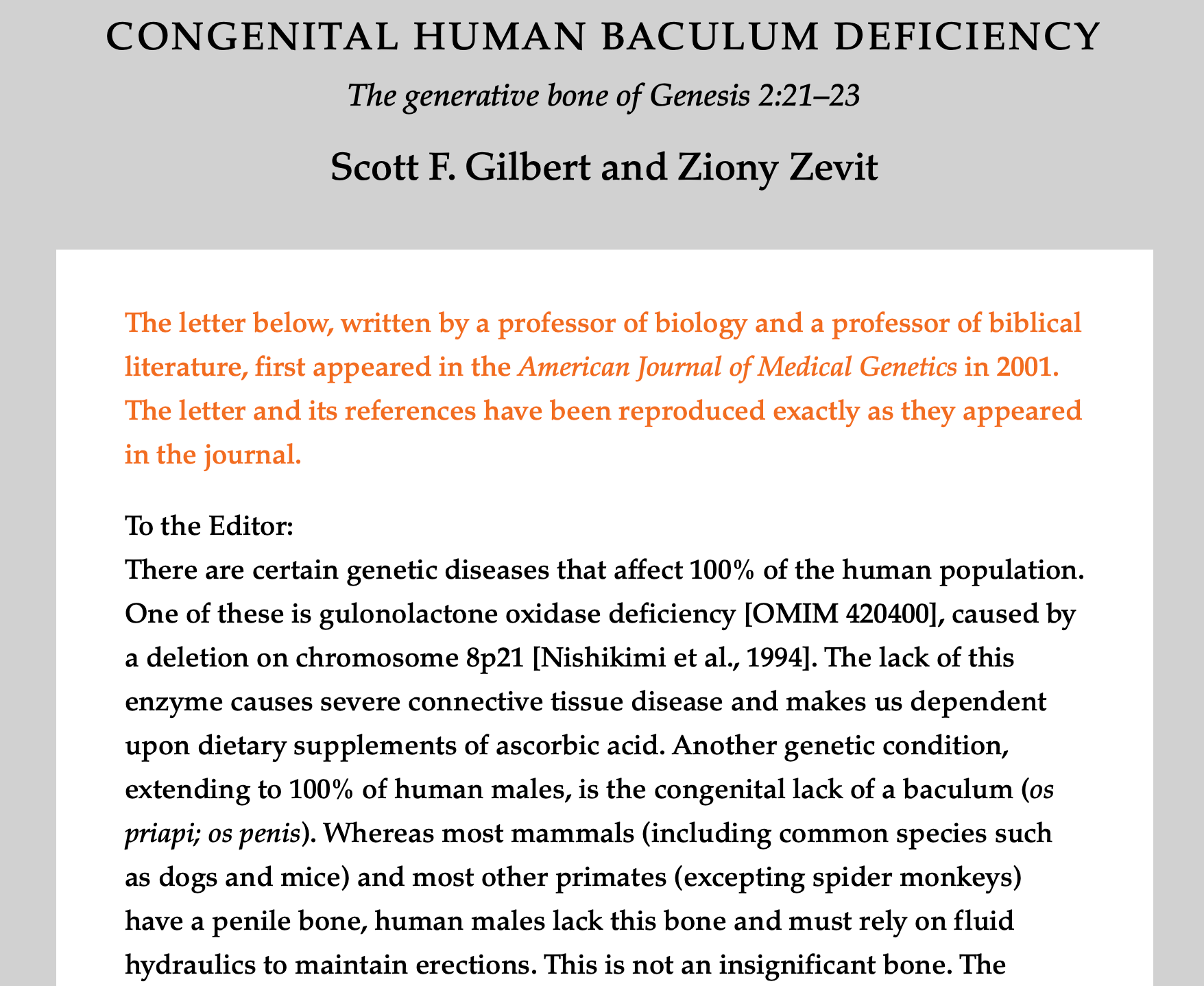
Thus I find myself a Zevitist—or maybe a “Baculist” is more coalitional—on the question of the biblical rib.
It’s frankly astonishing to me that, even though the slightly-mistranslated and censored version of this story is so widely known, it’s so rarely given enough thought for this to be a popular opinion. But the fact that I am not the only one to have seen through the words written—to the story as it was originally told—gives me hope. Rabbi Zevit and I both had the same insight independently, which assures me: we are part of a long tradition. As long as the story is still told in some way, there’ll be a few people in every generation who think about it until they get it, who go back to the old texts, who join this club that has no home in time or space, whose motto is: “They’ll never believe you.”
It’s too silly! Makes it seem too much like what it is: a prehistoric joke—one that caused such a ruckus around the campfire that it managed to get repeated and remembered until writing was invented.
But I think, like all good jokes, there’s a grain of truth at its heart. It’s still a good question: Why don’t humans have a baculum?
Scientists have speculated endlessly about the evolutionary pressure that led to “congenital human baculum deficiency”, as Gilbert & Zevit put it. It’s an intriguing puzzle, because when you see a trait present in every member of a species, and absent among every phylogenetically adjacent species, there’s a decent chance you’re looking at a speciating trait—the mutational fork at which two branches of the tree of life diverged. But baculum loss seems like it’d hurt your chances of passing on your genes, since even today it renders the human penis more susceptible to catastrophic breakage. (On Mother Nature’s cutting room floor, next to the heaped bodies of baby giraffes whose necks were too weak to handle the six-foot-drop that is the first thing one experiences upon being born as a giraffe, lies the pile of dudes who broke their dicks attempting a 720° Reverse Cowgirl Frontside Bluntslide. We weep for the giraffes, anyway.)1
In The Selfish Gene, Dawkins suggests that baculum loss is a bit of “honest signaling” like the peacock’s flashy tail—replacing the efficient baculum with an Inflatable Arm-Flailing Tube Man powered by blood pressure, to prove you’ve got the cardiovascular chops to sire healthy kids. This is not particularly compelling to me (in part because “it’s deliberately inefficient” can be used to wave away practically anything you can’t explain) and the theories only get worse from there: Go to the Wikipedia page for “baculum” and, as of this writing, you can still see someone seriously suggesting that proto-humans learned to break each other’s dick-bones in combat, and this rapidly extirpated those with a bone there to break.
But that’s generally not how evolution works: Evolution happens one freak, one mutation, at a time. At some point, a proto-human ape was born without a baculum, and our entire species as it exists today is descended from that first man. But if not because he, alone, could asymmetrically deploy the proto-human dick-bone kung-fu snap—then why? How could this crippling fragility be a fitness advantage?
It’s obvious, of course, if you put yourself in his shoes. You’re a mutant—although you might not know it. You’re probably not talking about it with your guy friends; maybe we don’t even have real language, yet. Maybe we’re still furry.
But for you, sex is not like for the rest of them. Unique among your species, you have to rely on some flimsy erectile tissue, effectively a chilly nipple. The other guys can just prop up the tent pole and go to town, while the best you can manage is some…engorgement.
In other words, you are the first guy in history who has to be very, very careful when putting it in.
You can’t even do so, really, without the full enthusiasm and assistance of your partner.
Without consent.
Baculum loss turns sex from what it is in the rest of the animal kingdom—“nasty, brutish, and short”—into something collaborative. Something requiring a lot of communication. Something, dare I say it? Tender.
So imagine what a sensation—what a revolution—this Adam must have been with the ladies! His first partner, perhaps confused by his difference, then amazed to discover: there’s a better way. It can be gentle. Pleasant, even.
You bet your ass she’s telling her friends about it! Words? Who needs ‘em! She’s dragging them over for show-and-tell, ook-ing and pointing, squeezing his junk to demonstrate, gesturing for them to do the same: No, feel! This one’s built different!
And I imagine our man, who never knew he was anything special, is probably thinking to himself something like: Okay, not sure what all this is about, but it seems like a good thing, right? Let’s play it cool, let’s see where this goes…and in a few generations, Adam is the common ancestor of all males in his local group; a floppy Genghis Khan who won supremacy not with strength, but with vulnerability.
Think of the balance of power between the sexes in a proto-human society, and how it would shift in such a tribe!
Who is the alpha? Who gets to breed this season? It’s not for the men to decide among themselves anymore; it’s each female’s choice.
Would we not expect that group to have an unusual degree of intimacy between partners? Unprecedented cooperativity among males, freed from the alpha/beta framework? With the monopoly of brute-strength-as-reproductive-fitness broken by this newfound physical fragility—giving females veto power over copulation—would we not expect an explosion of genetic diversity, as multiple males per generation get a chance to mate, competing on a playing field of the females’ devising? Might such a tribe not start selecting for things like cleverness, empathy, and the capacity to communicate?
Might that group not take over the whole goddamn world?
So maybe this is the grain of truth. Not as separate acts, but all in one fell swoop, God made man, and took the bone, and made woman his partner.
—🖖🏼💩
P.S.
I would be remiss not to discuss the other exceptional component of human reproductive anatomy: we have the largest penis-to-body-size ratio of any ape. For comparison, a well-endowed gorilla clocks in at somewhere around 2 inches.2
Why?
Here again, theories abound, but the true answer is self-evident once you hear it: If you want to understand the shape of a key, you have to look at the lock it was cut to fit. So we reframe the question: it’s not “Why do humans have such disproportionately large and girthy members?”, it’s “Why do humans have such disproportionately large vaginas?”
And the answer to that one is obvious: during birth, they have to accommodate our disproportionately large heads! As we entered the feedback loop of larger brains enabling higher cognition enabling the acquisition of more and better food, the human vagina—and by extension the penis—had to grow in parallel to the cranium. Perhaps the ultimate irony, then, is that we would eventually reach a point where male genitals were large and sturdy enough to enable the reinvention of rape.3 The stretch of history between baculum loss and this evolutionary threshold is, presumably, what we refer to when we talk about “Eden”: the days before Adam succumbed to Eve’s temptation and discovered what it means to be evil.
The males of that noble species have found an ingenious way of preventing this tragedy, i.e. walloping their heads into one another’s necks like wrecking balls to see whose is stronger. The first time you see it, you wince; it is brutal, it seems egregiously violent. But consider the fitness pressures on a giraffe: you want to be tall, so you can access higher tree branches and get more food. You can get taller either by adding length to your leg bones, or to your neck. Now, “longer stilts” is a lot less work than “longer neck”, because the latter requires your circulatory system to do some absolutely insane things in order to keep blood flowing to your brain (and more importantly, your jaw & tongue). But the giraffe body plan can’t just be “horse, but on really long stilts”, because they give birth standing up. Knowing that their whole fitness landscape is an optimization problem among leg length, neck length, and neck strength/flexibility, their game of neck-wrecking ball becomes an elegant example of the same “honest signaling” discussed above. Presumably, they could get out of this trap and go all-in on leg length if they could figure out a way to give birth lying down, but I guess that’s a lot to ask when “thinking” is third or fourth down the list of things your head is optimized for.
There’s gotta be at least one person out there with a gamertag like Gor1llaD1ck69, blissfully unaware of the implications.
Although this might have had more to do with the development of edged weapons like hand-axes, after which a male who’s just had his corpus cavernosum snapped could still be enough of a threat to end your life.
The title really doesn't do justice to this absolute chef's kiss of a post
Wow. Do you have like a lot of these takes just waiting to be written down and published? I want to read all of them.